Writing and drawing instruments of yesteryear were not as they are known today. Many early tools were about the size and shape of modern pencils, though the Roman solution, called a penicillum, meaning "little tail", was actually closer to a brush.

Another precursor came in the form of a lead or silverpoint stylus, used with bound wax tablets.
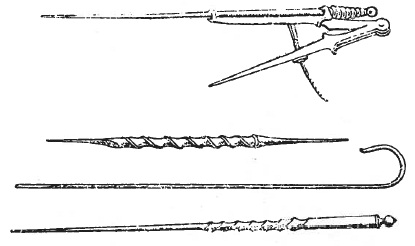
Eventually, pieces of lead, graphite or other materials were wrapped in paper, string, vine, etc. to be used as writing devices while not besmirching the user's hands.

Similarly, a holder, called a porte-crayon, gripped pieces of lead, chalk, charcoal or other medium.

There is a common misconception, perpetuated by a misnomer, that pencils are still made with lead. Though originally mistaken to be lead because of its color and shine, pencils today are made primarily of graphite, with the addition of a binding compound, typically ceramic clay. The ratio of clay to graphite affects the hardness of the pencil, giving each pencil a different ability to produce darker or thicker lines in an artistic work. The graphite, clay and water are mixed and processed into cylinders, which are pressed to a string through a cast. The graphite mixtures are fired to remove remaining water content, and dipped in a wax coating. The graphites are placed into grooved pieces of wood and sandwiched under another. Fibrous paper acts as a file against the pencil graphite, allowing different pencils to give rise to different lines. Designations of H and B are indicative of a scale of hardness of the material as well as darkness of the lines produced by the pencil; 6B is the darkest pencil of the set examined here, and 6H is the hardest. HB graphite is equivalent to a #2 pencil.
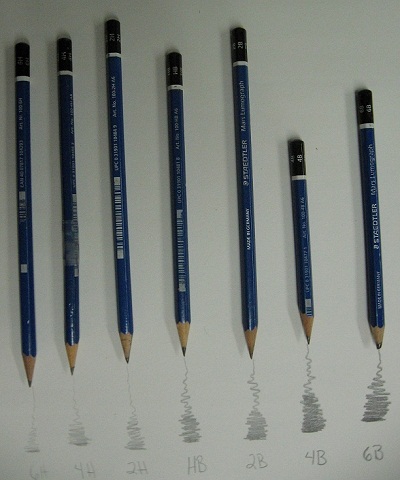
Seven modern artist pencils