The advanced certificate in high energy density science (HEDS) is the first integrated graduate credential in this emerging field. The program, which can be taken in-person or online, prepares students to apply high energy physics concepts to plasmas, high energy density materials, and astrophysics.
High energy density science (HEDS) is the study of matter at conditions so extreme that ordinarily incompressible materials, such as water or even steel, are compressed. For most materials, this occurs at energy density in excess of 1011 J/m3, or the equivalent of 1 million atmospheres (100 GPa) of pressure, at which point these incompressible materials are compressed by about a factor of 2x.
Home to the Laboratory for Laser Energetics
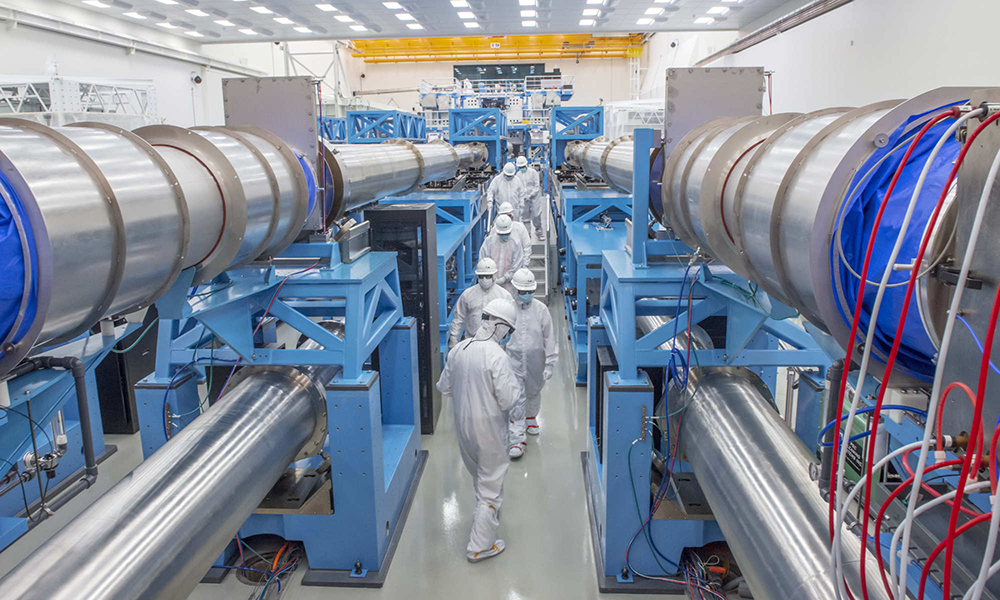
Since its founding in 1970 at the University of Rochester, the Laboratory for Laser Energetics (LLE) has been a central force in fusion and HEDS research and laser science and technologies.
The Omega Laser Facility at LLE serves an elite community of more than 800 researchers from over 70 institutions worldwide, including major national labs, who conduct over half of the experiments supporting national HEDS and fundamental science programs. This vibrant ecosystem, strongly rooted in academia, nurtures innovation and discovery while fostering the development of the next generation of researchers, engineers, and technicians.
Backed by federal and state sponsors, LLE advances both scientific excellence and workforce training, maintaining its position at the heart of the national fusion and HED community.
Hosted at the University of Rochester and designated as a National Science Foundation (NSF) Physics Frontiers Center, the Center for Matter at Atomic Pressures (CMAP) is a collaboration among faculty, scientists, researchers and students at MIT, Princeton, the Universities of California at Berkeley and Davis, the University at Buffalo, and the Lawrence Livermore National Laboratory.
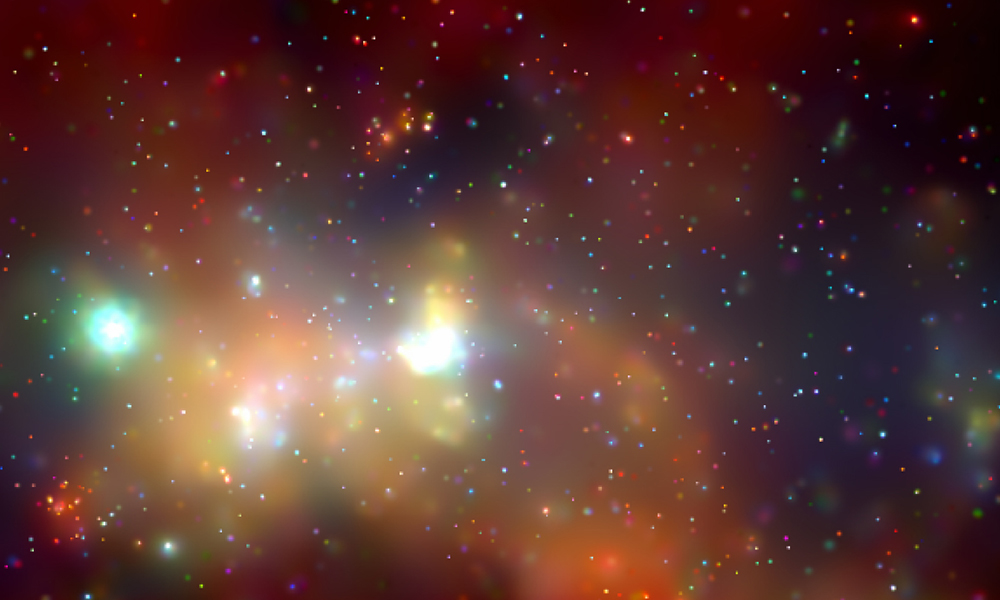
By combining the talent and resources of leading institutions from across the country, CMAP researchers conduct laboratory-based exploration of planets and stars throughout the universe, including revolutionary states of matter right here on Earth.
My PhD at the University of Rochester’s Laboratory for Laser Energetics provided a rigorous foundation in inertial confinement fusion (ICF) physics, combining experimental design, analytical theory, and simulation to study implosion hydrodynamics. Working in one of the world’s premier ICF research environments taught me how to connect detailed physics understanding with large-scale experimental systems. This experience directly prepared me for my role at LLNL and now at Xcimer Energy, where I apply those same principles to the design, modeling, optimization, and systematic risk retirement of high-gain laser fusion targets.
Alison Christopherson ’20 PhD (mechanical engineering)Head of target design at Xcimer Energy Corporation
I studied HEDS at the University of Rochester, where I conducted experiments on the OMEGA and OMEGA EP laser systems to investigate the behavior of materials under extreme pressure. My academic training and hands-on experience at LLE laid a strong foundation for an exciting career at Lawrence Livermore National Laboratory (LLNL). There, I had the opportunity to lead and participate in HED experiments at premier facilities around the world. My time at the University of Rochester was instrumental in preparing me for a dynamic and impactful career in applied experimental science.
Dayne Fratanduono ’10 PhD (mechanical engineering)Deputy director of the National Ignition Facility