
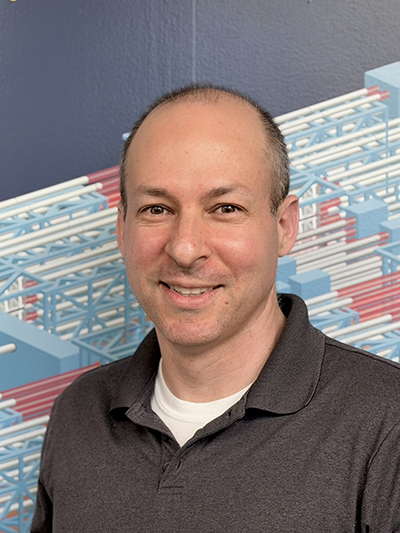
Zachary Robinson
Assistant Professor (Research)
Scientist, Laboratory for Laser Engergetics (LLE)
PhD, SUNY Albany College of Nanoscale Science and Engineering, 2012
Biography
After finishing his undergraduate degree in Physics at SUNY Geneseo, Professor Robinson did his PhD in the Surface Science group of Dr. Carl Ventrice studying graphene synthesis. He then did a three year postdoc in Dr. Chip Eddy’s group at the U.S. Naval Research Laboratory in Washington, DC where he continued studying 2D materials and ultra-thin films. After finishing his postdoc, Professor Robinson joined the faculty at SUNY Brockport in the Physics Department, where he studied ultra-thin neuromorphic computing materials, won a SUNY Chancellor’s Award for teaching, and was awarded several DOD and NSF grants to fund his research. Professor Robinson joined the Laboratory for Laser Energetics (LLE) in 2024 as a research scientist, where he primarily studies surface and materials science challenges related to the fusion fuel supply. Professor Robinson has been on the executive committee of the New York State section of the American Physical Society since 2016, and chairs the American Vacuum Society’s Focus Topic on Fusion Energy.
Research Overview
Professor Robinson studies materials and their interactions with tritium, which is the radioactive mass 3 isotope of hydrogen. He is an experimentalist, and works closely with theory and computational groups to better understand how to design materials and interfaces to better contain tritium and separate it from other hydrogen isotopes. His current projects focus on developing new instruments, materials, and material synthesis systems for the fusion fuel supply, so that a better fundamental understanding of tritium material interactions can be developed. Specifically, he is working on 2D materials, atomic layer deposition (ALD) of various ultra-thin oxide, nitride, and nanolaminate materials, and new instruments and control systems to enable studying these materials using the tritium facilities maintained by the Tritium Science group at LLE.
Student Outlook
Students who join Professor Robinson's group can expect to learn about thin-film deposition, characterization, instrumentation control systems, vacuum systems, automation, safety, temperature control, and how to perform systematic experiments. They work on collaborative projects within the Tritium Science group, and have a wide network of collaborators.
Selected Publications
- Argon-assisted growth of epitaxial graphene on Cu (111). Zachary R Robinson, Parul Tyagi, Tyler R Mowll, Carl A Ventrice Jr, James B Hannon. Physical Review B—Condensed Matter and Materials Physics 86 (23), 235413, 2012.
- Influence of chemisorbed oxygen on the growth of graphene on Cu (100) by chemical vapor deposition. Zachary R Robinson, Eng Wen Ong, Tyler R Mowll, Parul Tyagi, D Kurt Gaskill, Heike Geisler, Carl A Ventrice. The Journal of Physical Chemistry C 117 (45), 23919-23927, 2013.
- Measurement of the crystallization and phase transition of niobium dioxide thin-films using a tube furnace optical transmission system. Zachary R Robinson, Karsten Beckmann, James Michels, Vincent Daviero, Elizabeth A Street, Fiona Lorenzen, Matthew C Sullivan, Nathaniel Cady, Alexander C Kozen, Jeffrey M Woodward, Marc Currie. AIP Advances 14 (11) 2024.
- Development of an atomic layer deposition system for deposition of alumina as a hydrogen permeation barrier. Zachary R Robinson, Josh Ruby, Tyler Liao, Luke Herter, Rashad Ahmadov, Mark D Wittman, Matthew Sharpe, Jeffrey M Woodward, James H Michels, Alexander C Kozen. Journal of Physics: Materials 9 (1), 015007, 2026.